For many centres, physical classes remain the default recommendation, with online or hybrid lessons treated as a fallback. We were strongly against the online format too.
Large video-style lectures felt like a weaker substitute for attentive in-person tutoring, and we were not comfortable compromising lesson quality.
COVID forced us to experiment. The early lessons were awkward. We tried different ways of teaching before shared digital whiteboards became central to the method.
That changed our view. Once we could see every student's working as it developed, online lessons stopped feeling like a compromise. When we later returned to physical lessons, the old format felt strangely limiting.
The advantage was not “online” by itself. The advantage was visibility.
The Real Question Is Not Whether the Tutor Can See the Student
Parents often ask whether students can really stay focused online. That is the right concern, but the answer is not what most would suspect.
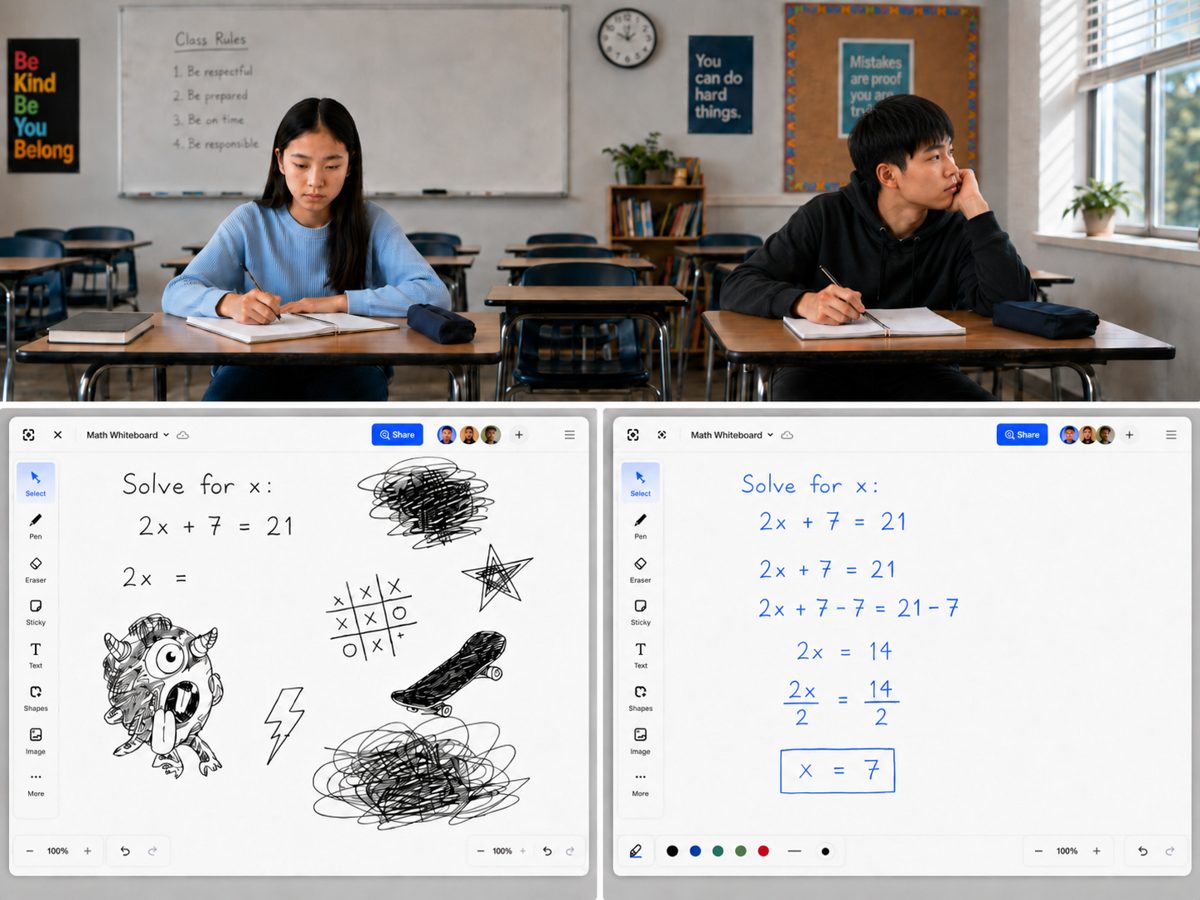
In a physical class, the tutor can see a student sitting upright, holding a pen and looking at the worksheet. But that is not the same as seeing the student's thinking.
Posture can suggest focus. The whiteboard shows the thinking.
If we covered the whiteboards, it would be natural to judge by posture: one student looks diligent, the other distracted.
But posture is only a weak proxy. A student can sit upright and still be lost. Another can look away briefly and still be following the method.
In math, the real evidence is the working: the steps written, the steps skipped, the hesitation before a line, the wrong turn, the careless slip, and the point where the method breaks down.
Tutor view
The Difference Is in the Working
This is what online visibility changes: the tutor is not guessing from posture. Each whiteboard shows the exact route a student is taking, including hesitation, wrong turns and moments where attention drifts.
The Math GuyLive
Student ATrig detour
Loading whiteboard…
Visible to tutorRight idea, wrong setup
A starts with trigonometry, sets it up wrongly, then switches to Pythagoras and solves it. The tutor can show that both methods work here, then correct when and how to apply the first method.
Student BLate start + doodle
Loading whiteboard…
Visible to tutorAble, but attention drifts
B solves the question once he starts, but the late start and quick doodle midway suggest attention may be slipping.
Student CMethod uncertainty
Loading whiteboard…
Visible to tutorRight method, shaky relationships
C uses Pythagoras from the start, but hesitates over how the sides relate. That gives the tutor a precise misconception to correct.
All three students eventually reach the answer, but the live process tells three very different stories. A starts with a valid method but applies it wrongly, then switches away. B delays, doodles, then rushes through. C uses the expected method but hesitates over the relationship between the sides.
Those are different teaching moments: method choice, attention, and conceptual precision. If the tutor only sees the final working, they can look almost identical. Live whiteboards preserve the thinking as it happens, so feedback can target the exact misconception, hesitation or attention gap.
Side-by-side view
All three boards at one glance
This view trades some detail for pattern recognition: who starts immediately, who hesitates, who changes route, and where attention seems to drift.
Side-by-side replay
A
B
C
Student ATrig detour
Right idea, wrong setup
Student BLate start + doodle
Able, but attention drifts
Student CMethod uncertainty
Right method, shaky relationships
Visibility changes the lesson
When the work is visible, feedback can happen while it still matters.
Visibility Works Best When the Lesson Matches School
The online advantage is much weaker if tuition is covering a different topic from school. Students naturally prioritise school exams. If they are struggling with this term's school topic, it is harder to fully focus on a separate tuition agenda that feels less urgent.
When tuition is in sync, the lesson becomes immediately relevant. We can clear the cobwebs from what happened in school, then use the whiteboard to see exactly where the student is still unsure.
In sync, students return to school ready to absorb more, then come back to tuition prepared to go deeper. School reinforces tuition; tuition reinforces school.
What changes online
From Checking Answers to Seeing Thinking
Shared whiteboards let the tutor teach in a different rhythm: explain briefly, watch the attempt, correct the exact gap, then raise the difficulty.
01
Misconceptions surface earlier
We do not need to wait until the final answer to find the problem. The wrong assumption often appears halfway through the working.
02
Attention becomes easier to read
A long pause, a sudden doodle, or repeated hesitation tells the tutor something useful even before the student says anything.
03
Feedback becomes more precise
The tutor can respond to the exact line where understanding breaks down, instead of giving a generic explanation after the fact.
Shorter Learning Loops
A learning loop is simple: learn something, try a question, expose the gap, fix the gap, then try again.
In a traditional classroom, that loop can stretch over days. A teacher explains a topic, sets homework, collects it later, marks it later still, then goes through common mistakes after the moment of confusion has passed.
With shared whiteboards, the loop can happen within minutes. The tutor sees the mistake as it appears, corrects it immediately, and gives the student another attempt while the idea is still fresh.
That matters even more when questions become complex. Long solutions are not just about understanding; they are also about retention. Closing the loop quickly allows the student to repeat the method enough times for it to stick.
The old method was not foolish. It made sense for the tools available at the time. In a physical classroom, the teacher cannot stand beside every desk at once, so the natural rhythm is to teach first and check later.
Technology changes that rhythm. With digital whiteboards, every student's working can be visible at once. The tutor can teach a little, check immediately, adjust quickly, and repeat.
We have also seen schools such as RI and RGS use collaborative whiteboards even in physical classrooms. When teachers have both options and still choose the whiteboard workflow, it suggests the value is pedagogical, not merely logistical.
Online Is Not Our Fallback
For us, online tuition is not a compromise. It is the format that best supports our teaching method.
The goal is not simply to save travel time. The goal is to make learning visible. When learning is visible, teaching becomes sharper. When teaching becomes sharper, students improve faster.
See the Difference Visibility Makes
Enquire about a class for your child's school and year.
 The Math Guy